English| EUR
Suggested for you
More currencies
Choose a language
Volcano boarding is exactly what it sounds like: riding a reinforced board down the steep, ash-covered slopes of an active volcano at speeds that can reach 50 miles per hour. Born on Cerro Negro in 2005, this adrenaline sport has turned a remote Nicaraguan peak into a pilgrimage site for thrill-seekers worldwide. The combination of volcanic scree, gravity, and protective gear creates an experience that sits somewhere between sledding, sandboarding, and controlled avalanche.
Quick answer
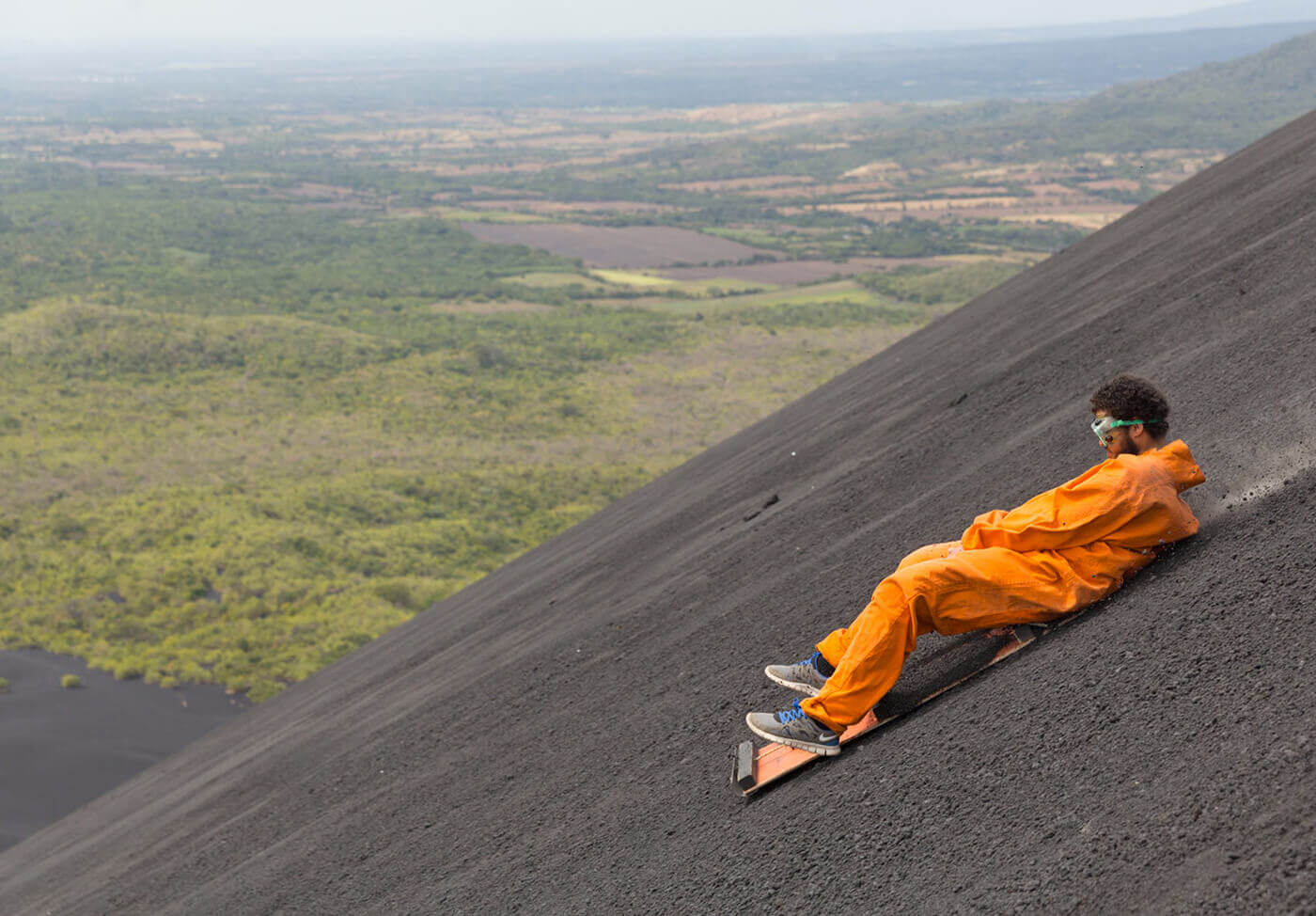
Volcano boarding is an extreme sport where riders descend the volcanic ash slopes of Cerro Negro on a reinforced plywood board, reaching speeds of up to 50 mph. Invented in 2005 by Australian Darryn Webb, the activity uses a sit-down or stand-up technique on a specially designed board with a metal base and rope handle. The 41-degree slope and fine black gravel create ideal conditions for the descent, which typically lasts 60 to 90 seconds from summit to base.
The sport exists because of Cerro Negro's unusual geology. Unlike older volcanoes with compacted slopes, this 167-year-old cone sheds layers of loose basaltic scree with every eruption—the most recent in 1999—creating a surface that behaves like ball bearings underfoot. That instability, combined with the mountain's consistent 41-degree pitch on its northwest face, produces the friction-and-release dynamic that makes boarding possible. The black volcanic gravel heats quickly under the tropical sun, and by midday the surface temperature can exceed 120°F, another reason most descents happen in early morning. What is volcano boarding in practice? It's a 45-minute hike up carrying a wooden board that weighs roughly 15 pounds, followed by a descent that compresses all the effort into 90 seconds of speed. Riders sit or crouch on the board, gripping a rope handle, and lean back to control velocity. The boards themselves are purpose-built: plywood reinforced with Formica or metal sheeting on the base, a design refined through two decades of trial. There are no bindings, no brakes, and no second runs without another climb. The volcanic ash infiltrates every layer of clothing, and even with goggles and coveralls, riders finish coated in fine black dust. The activity emerged from the adventure-tour economy that took root in León after Nicaragua's civil conflicts ended. What began as one operator's experiment is now offered by multiple outfitters, each running daily departures to the volcano. The boards, the protective gear, and the trails are all standardized, but the experience remains raw. Cerro Negro is still an active volcano, and the park entrance fee supports monitoring and trail maintenance. The descent itself requires no prior experience, though courage and a tolerance for grit help. Most riders fall at least once, and the ash provides a softer landing than rock—though the abrasion is real. Volcano surfing, as some call it, hasn't spread beyond a handful of sites worldwide. Cerro Negro remains the most accessible and the most consistent, its young surface replenished with every seismic shift. The sport's appeal lies in its simplicity: gravity, geology, and a board. No chairlift, no snow season, no waves to wait for. Just the hike, the view from the summit, and the commitment to point the board downhill.
“The black volcanic gravel heats quickly under the tropical sun, and by midday the surface temperature can exceed 120°F.”
Volcano boarding at Cerro Negro follows a structured sequence: a 45-minute hike to the summit, a safety briefing with equipment distribution, and a high-speed descent down the volcanic scoria slope. The entire experience takes approximately 2-3 hours from base to finish.
The ascent covers roughly 500 vertical meters on loose volcanic rock—wear closed-toe shoes with grip and bring water, as the black scoria absorbs heat and shade is nonexistent. Most people underestimate the steepness and arrive at the top overheated.
Guides distribute wooden boards with metal bases, goggles, gloves, and a jumpsuit at the crater rim. The single mistake here is skipping the goggle fit check—loose goggles fill with dust within seconds of descending.
The briefing covers body position (lean back, feet forward on the board's footrests), braking with your heels, and the hand signal to abort if you lose control. People who ignore the "lean back" cue flip forward on the first steep section.
You sit on the board and push off, reaching speeds up to 50 km/h depending on your weight and how aggressively you brake. The ride lasts 1-2 minutes, and the scoria dust cloud behind you is unavoidable—keep your mouth closed.
Hand back the board, goggles, and jumpsuit at the staging area and shake out the volcanic grit that will have infiltrated every seam. Most operators provide a basic brush or air blower for gear and backpacks.
Cerro Negro is open for visitors seven days a week. The site maintains consistent daily operating hours throughout the year.
Volcano boarding on Cerro Negro requires specific gear and advance planning to handle the ash, slopes, and exposed conditions.
Everything you need to know about what is volcano boarding
Volcano boarding is an adventure activity where participants slide down the steep, ash-covered slopes of a young volcano using a specialized wooden board. Cerro Negro is the primary destination for this experience in Nicaragua, offering a unique way to navigate the volcanic scree. Learning what is volcano boarding helps visitors understand the physical nature of the descent. It remains a popular way to engage with the local landscape and experience the thrill of gravity on a live geological formation.
Safety is prioritized by guides who instruct participants on proper braking techniques and body positioning to maintain control during the descent. While the slope is steep and composed of loose volcanic rock, following the guidance of professionals is essential. Understanding what is volcano boarding allows participants to manage their speed and ensure a controlled experience on the mountainside. Most tours provide protective equipment including jumpsuits and goggles to guard against loose debris.
Wearing long pants and sturdy, closed-toe shoes is necessary to protect against the abrasive volcanic soil and potential scratches. You will also be provided with protective gear, such as a specialized suit and goggles, to ensure safety during the ride. Knowing what is volcano boarding encourages guests to dress appropriately for an environment characterized by fine dust and intense sun. Bringing extra water and sunscreen is recommended to manage the dry, exposed conditions.
The hike up the volcano requires moderate fitness as it involves climbing a loose, gravel-like path to the summit. Once at the top, the descent is managed by the rider, meaning you can control your speed during the experience often called volcano surfing. If you are curious about what is volcano boarding, you should know that most people with a baseline level of physical ability can successfully complete the trip. It is more about balance and listening to instructions than extreme athletic prowess.
The park entrance fee is 10 USD per person. This fee is separate from any tour operator charges and is paid directly for access to the protected area. Always carry cash in the local currency or USD to ensure you can settle this payment upon arrival.
The best arrival window is between 07:00 and 10:00 to avoid the peak midday heat and the stronger winds that often develop later in the day. Arriving early ensures a more comfortable climb up the slope of the volcano. Planning your visit within this timeframe helps you bypass the most intense environmental conditions on the open mountain face.
No prior experience is necessary, as guides provide comprehensive training on how to operate the board before your run. You will learn the basic technique of leaning back to increase speed or dragging your feet to slow down. This activity, sometimes described as sliding down Cerro Negro, is designed to be accessible to adventure seekers of various skill levels.